Hardwood Floor Drying Fresno
Hardwood floor drying uses a specialty mat system that seals to the floor surface and draws water up through the seams and out of the wood using negative pressure. Panels connect to an extraction unit, air movers push…
Hardwood floor drying uses a specialty mat system that seals to the floor surface and draws water up through the seams and out of the wood using negative pressure. Panels connect to an extraction unit, air movers push…
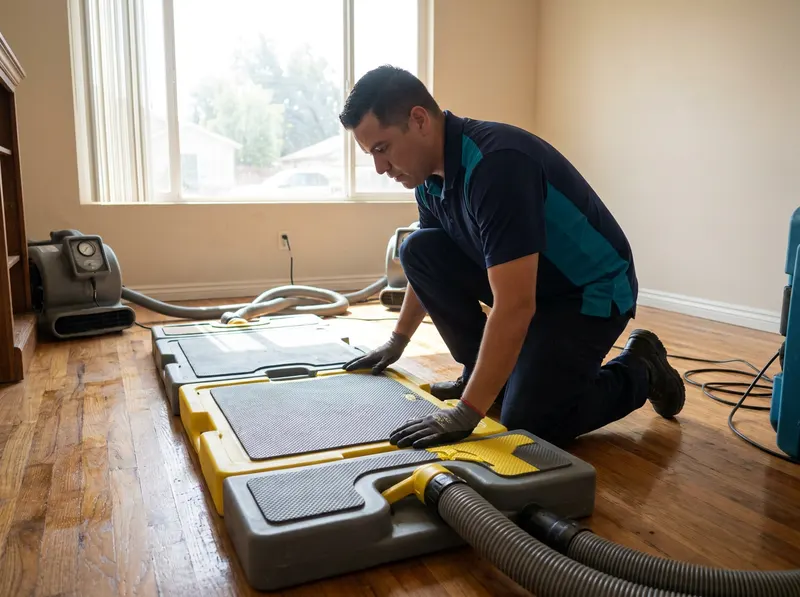
Hardwood floor drying uses a specialty mat system that seals to the floor surface and draws water up through the seams and out of the wood using negative pressure. Panels connect to an extraction unit, air movers push warm air across the boards, and a dehumidifier removes the released moisture from the room air. The goal is a moisture content of roughly 6-9%, which is the equilibrium range for wood in Fresno's dry San Joaquin Valley climate. Daily meter readings track progress; drying stops when three consecutive readings hold steady.
Drying fits situations where the water was clean or lightly contaminated and the boards are cupped but not crowned, split, or lifting at the tongue-and-groove. A dishwasher leak in a Fig Garden kitchen, a supply-line burst in a Woodward Park hallway, or an upstairs bathroom overflow reaching a downstairs oak floor are common candidates. If planks have already crowned, delaminated at the veneer, or blackened from Category 3 water, replacement of those sections is the realistic path and drying only protects the surrounding subfloor. Engineered planks with a thin wear layer are harder to save than 3/4-inch solid oak because the veneer swells fast; a moisture reading and a visual check of the plank edges settle which route applies. If the cupping is mild and caught within a few days, mat drying often restores the floor flat; if the boards are lifting or the subfloor is saturated, partial replacement plus drying of the structure below is the honest recommendation.
Fresno's low humidity is an advantage here. Outdoor relative humidity often sits below 30% in summer, so dehumidifiers reach low grain-per-pound targets faster than in coastal cities, and floors frequently dry on the shorter end of the range. Slab-on-grade homes across Clovis and southeast Fresno hold moisture differently than raised-foundation properties near the Tower District, so the equipment plan and drying time are matched to the construction. Concrete slabs can wick water back into the wood, which is why moisture readings continue at the subfloor, not just the plank face.
A typical drying sequence runs in order: 1) map the wet area and mark the moisture-content baseline; 2) seal the drying mats over the affected boards; 3) run extraction, air movement, and dehumidification together; 4) log meter readings each day; 5) remove equipment once the wood holds a stable 6-9% and inspect for residual cupping. Any board that stays crowned after drying is flagged for sanding or spot replacement, which is quoted separately from the drying work.
Every job gets a firm, written price after a free on-site visit.
Tell us about your hardwood floor drying job in Fresno and we'll send a clear, written quote, usually the same day.